One digital twin. Five ways to use it.
Every module reads from the same evidence-backed map of your firm's capabilities. Unlock staffable work, win public solicitations, score a pursuit, question the roster, or price the risk: it is one twin, answering five ways.
Staffable work, found and priced
Atlas weighs every colleague's utilization against targets and connects the hours you are already paying for to the work in front of you: the won projects sitting short of people, and the public solicitations your bench could win.
Every unlock is a priced move for a named person, reallocation or cross-training, never a hire. The result is revenue you can claim this quarter, with the evidence attached.
- Won work made staffable through priced reallocation and cross-training
- Public solicitations scanned nightly and matched to your bench
- Cost-competitive team alternatives that protect your margin
$86.3M of active pipeline, you didn't know you could staff.
- $47.5Mstaffable todayof current pipeline, zero new hires, moves included
- +$0.0Munlockedthrough reallocation and cross-training, zero hires
- $12.4Mexternal work in reachcurrently staffable, from 46 open solicitations scanned against your bench
- Environmental 2 compliance seats cross-trained+$4.6M
- Civil & Transportation 3 reallocations across benches+$3.2M
- Structural 1 senior move unlocks a program+$2.0M
Six priced moves, each a named person, zero hires.
What remains after the moves: $29.0M short, every gap named, the fix priced at $400K.
every number opens to its evidenceWinnable public work, found overnight
Atlas automates your business development. Every night it reads every open solicitation posted across the public procurement portals, SAM.gov, Caltrans, city and county sites, and matches each one against your whole firm's bench: cited capabilities, live utilization, real billing rates.
Only the work you can actually win surfaces. Each pursuit arrives with the team named seat by seat, delivery priced at your own rates, and the margin computed, in your BD team's inbox before the morning coffee.
- Every open solicitation read nightly across 46 public portals
- Matched against 4,324 cited capabilities and live utilization
- Winnable pursuits arrive with teams named, priced, and emailed to your BD team
Built from the whole firm's bench, every seat available today. No new hires.
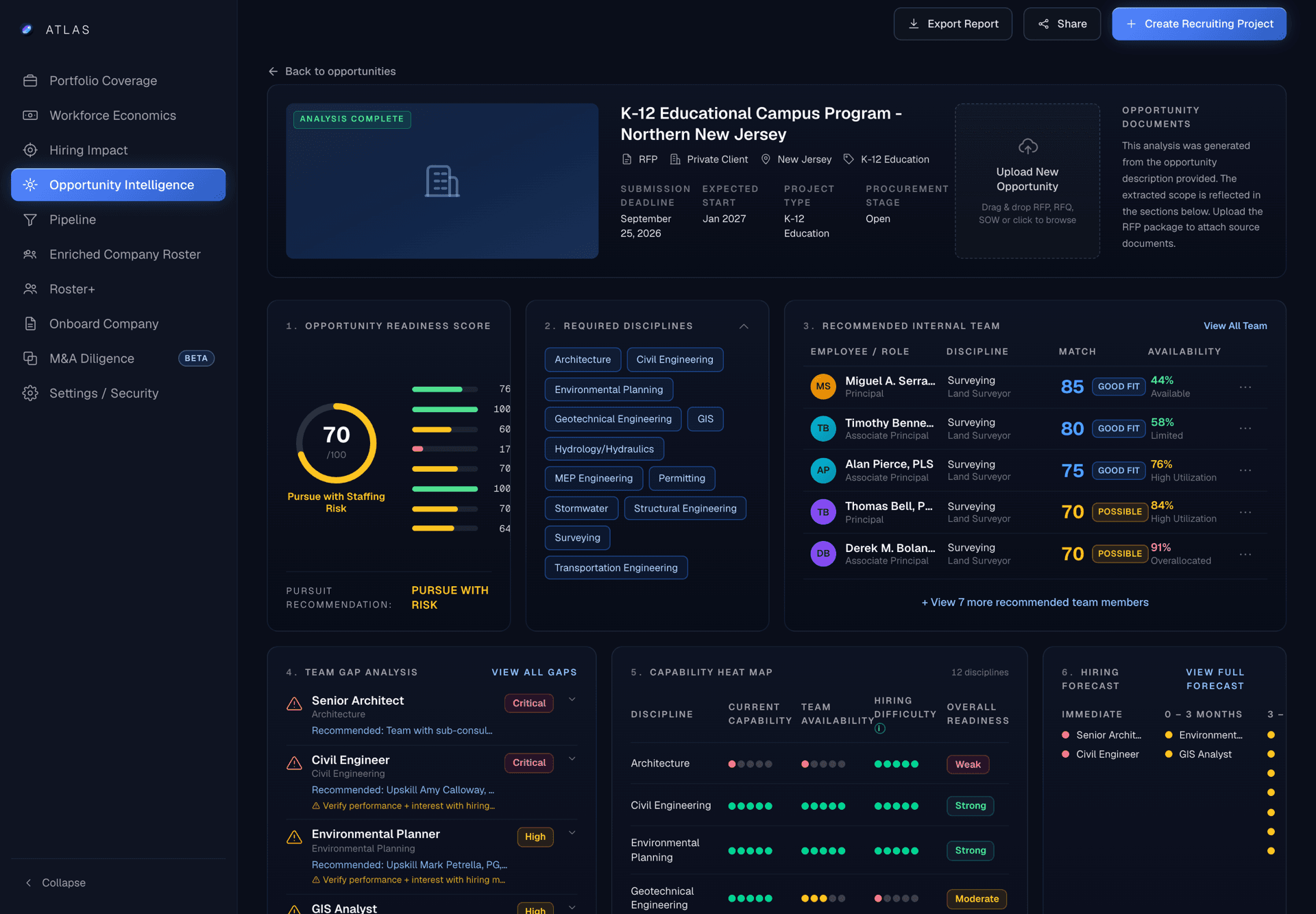
Pursuit readiness, before you commit
Feed Atlas the RFP. In seconds it reads the requirements, matches them against your firm's actual delivery record, and tells you whether you can staff the work you are about to chase.
The answer is never a black box: every readiness score comes with the drivers behind it, cited to the evidence they came from.
- A readiness score with cited drivers
- A recommended team pulled from your own bench
- A gap-closure plan with hire, subcontract, and upskill timelines
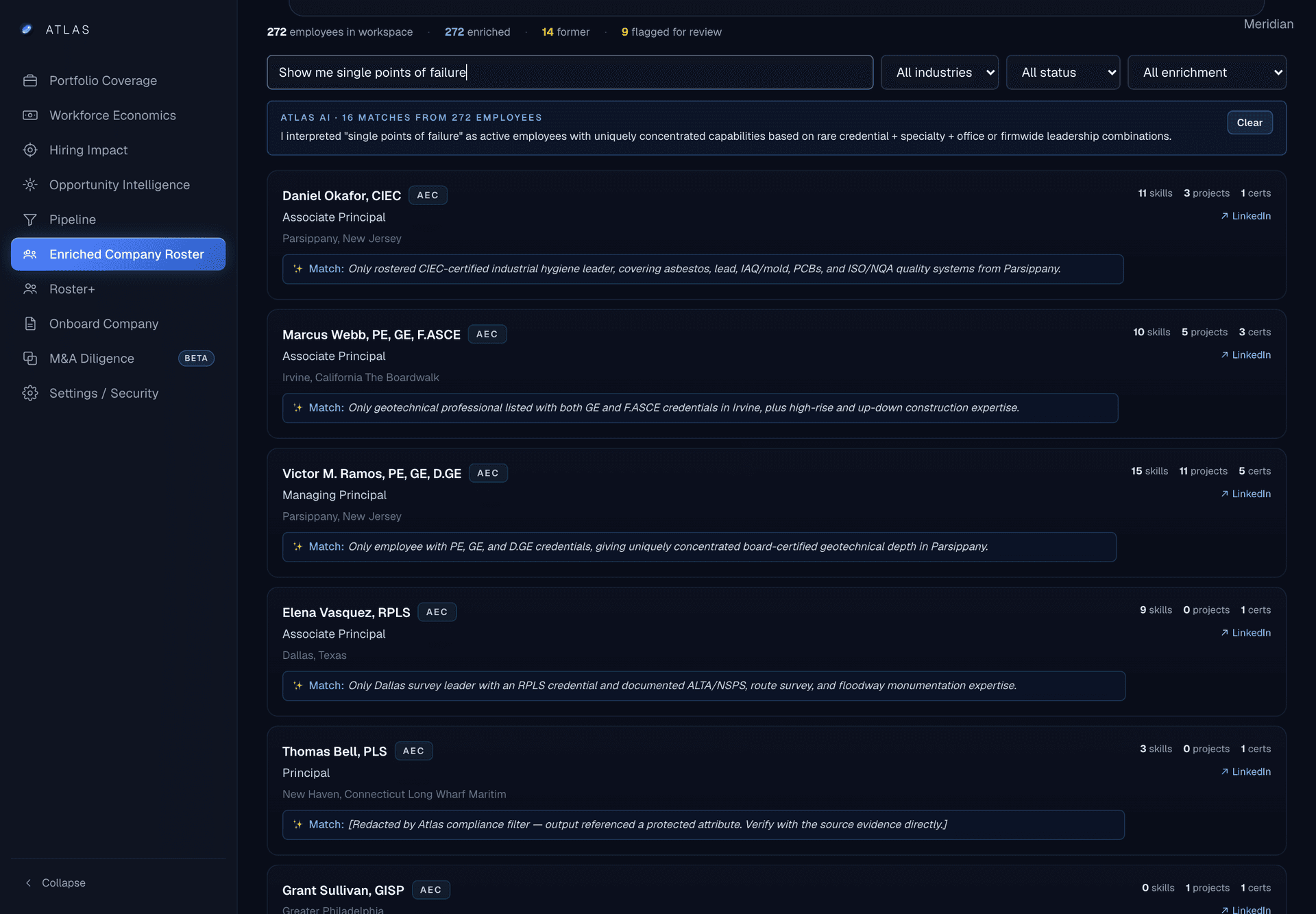
Ask your organization anything
“Who has run a hospital job over $50M?” “Who else can stamp drawings in Nevada?” Ask in plain language and Atlas answers from the digital twin, with the evidence attached.
It also tells you what you didn't ask: where one resignation would take a capability to zero, and where credential coverage is thinner than the org chart suggests.
- Plain-language questions, cited answers
- Single points of failure flagged before they bite
- Credential and license coverage across every employee
Capability gaps, priced in dollars
A gap is an abstraction until it has a price. Portfolio Coverage connects your capability map to your client relationships and quantifies what is actually at stake.
Leadership sees revenue at risk, the cost to protect it, and which client relationships depend on capabilities the firm holds thinly.
- Revenue at risk, by client relationship
- The cost to protect it: hire, subcontract, or upskill
- What-if scenarios run against the live roster and pipeline
You're on track to win $29M of work you can't staff.
- Confidential hyperscale developer75GOOD$12.5M
- Mid-Atlantic private university83STRONG$8.5M
- Brooklyn residential developer100STRONG$5.2M
- NJ schools development authority86STRONG$2.8M
Weighted across six active client relationships, recomputed as the roster and pipeline change.

From pursuit to mobilization: know the team before you commit the schedule.
AI finds the evidence. Math does the scoring.
No black boxes. Atlas's AI gathers and cites the evidence; deterministic scoring does the judgment.
In practice that means the language model never decides your readiness score. It reads public records, extracts claims, and attaches sources. Then deterministic math, the same math every time, turns that evidence into scores you can defend in a go/no-go meeting.
Cited, always
Every answer links to the evidence behind it, 100% of the time.
Corroborated 3×
Nothing locks until three independent sources agree.
Deterministic scoring
Readiness scores come from transparent math, not model mood.
Instant answers
Seconds from question to answer, across your whole roster.